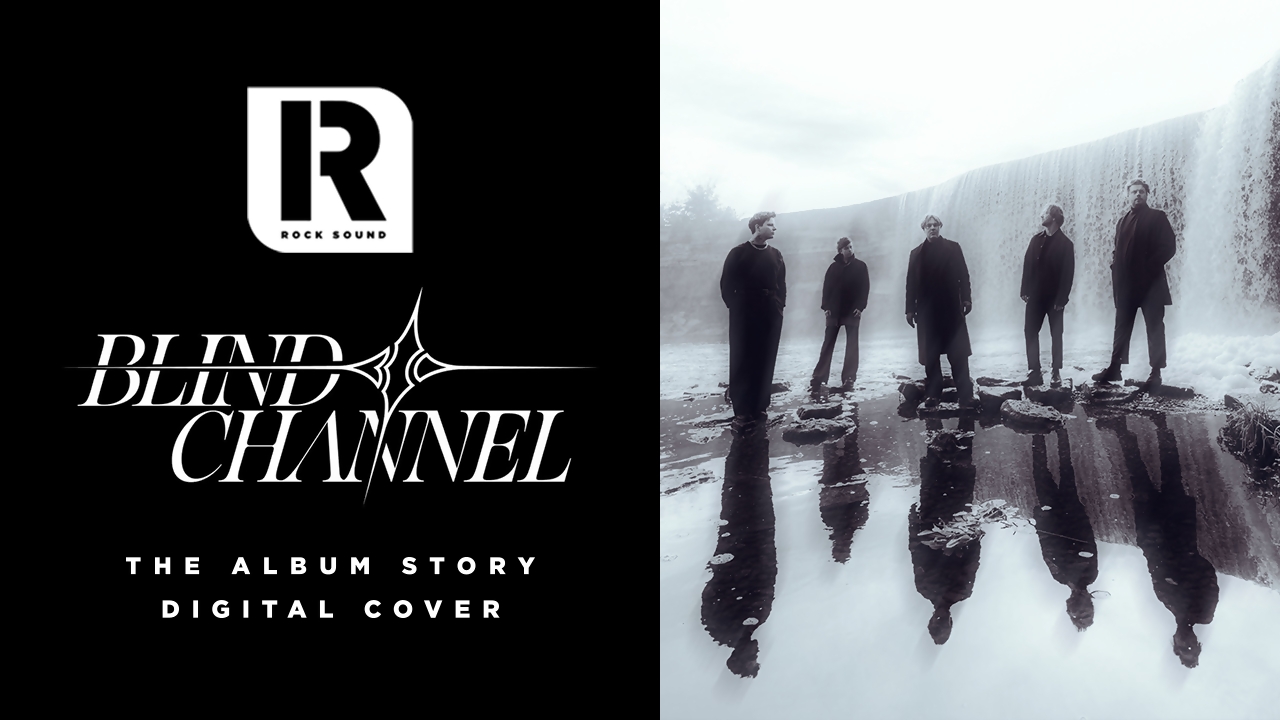
Read Blind Channel ’Painstream’ | The Album Story below:
(Click ‘View Fullscreen’ for digital feature or scroll down for text only version)
TEXT ONLY
As Ferris Bueller once said after the best day off ever, “Life moves pretty fast. If you don’t stop and look around once in a while, you could miss it.”
Wise words are wise forever, which means that they even apply to where Blind Channel found themselves at the end of 2024. After a whirlwind few years, from Eurovision stardom to worldwide acclaim, taking a step back to evaluate where they were, musically, as they plotted their next move, led to one hell of a realisation.
“We noticed that we would just go to the studio and the vibe would be something like, ‘Let’s just make another song. We know how to make these songs’, and we realised that music should never feel like that,” vocalist Niko Moilanen notes. “We want every song to be a journey and an exploration into the world, as well as yourself. And we know that’s hard to find if you’re always working to a deadline. That’s when we knew we needed to have a break.”
20 months later, and taking back control of every aspect of who they are, especially musically, the band have a new record, ‘Painstream’. The result of stripping away the bullshit and doing exactly what comes naturally is an atmospheric, bludgeoning, thoughtful race through what it means to live on your own terms.
A deeply human, vulnerable, and celebratory listen, it is everything Blind Channel should be, presented in their most confident, considered form.
“If we were going to keep doing this, we needed to ask ourselves what is going to stay the same and what’s going to change. There was a lot of shifting within our mindset, and now we are so proud to be able to stand behind everything that we have done here.”
THE LYRICS
Up until now, Blind Channel’s view on the world, and how things are, was more rooted in oblivion than observation. Their discography before ‘Painstream’ is more readymade for the dancefloor than the diary entry, something that Niko describes as a more “nihilistic” stance than where they are now. But eventually, the music stops, the house lights go on, and you have to walk out into the real world and face what is actually happening. And that’s very much where these songs have their home. Rather than hiding from the feelings circulating through their system, the band faces them head-on, no matter how scary that is.
“We’ve tried to be as authentic as possible, always,” Niko hammers home. “But if you think about five years back, our approach to lyrics was, ‘The world’s on fire, we’re all going to die, nothing matters, let’s party’. And that is authentic when you’re in your 20s. You’ve just had your first breakthrough, you’re taking on the world, and you feel immortal about everything.
“But then, after a while, we had to stop and see what truly matters. We’re still as ambitious as ever, but we realise no amount of success brings happiness. Happiness is somewhere else, and you have to start looking for it. I don’t know if we have found it, but right now, I’m just so grateful we get to keep doing this, and to have conversations about these sorts of things.”
Actually, talking seemed to be the biggest catalyst for the direction where the themes of ‘Painstream’ would head. Not in the midst of a massive tour or promo session, but just existing as five friends outside of music, the band were able to acknowledge how special what they have is, and how much, outside what is expected of them, truly matters.
The realisation that the world is a beautiful place that is worth fighting for. The fact that the only way to let kindness and light into your life is to believe in it. The understanding that there is more to this existence than what you have achieved, and that there is more to learn from the person standing next to you than from staying inside your own head.
The result is a complete evaluation of the human condition, as much as it is a cleansing of the things that muddy your view of what is truly important. For Niko, without mincing his words, it was about “pulling our heads out of our own asses”.
“It just didn’t feel right to sing how hard my life is or how awesome I am. Those things didn’t feel relevant. We wanted to sing about how we see the world and the problems that we see within it. We talk about where we see hope, or what we have found that makes us feel hopeful. Really digging into the base values of what a human being means to us.”
That’s where you find a track like ‘Youthanasia’, which looks at what it means to cut ties with the older version of yourself, and ‘Me Versus Me’, which shows that the biggest battle of all is the one inside your head and your heart. The same goes for ‘Villain In Your Story’, where the difficulty of admitting you’re in the wrong comes to a head. Then there is ‘Diana’, inspired by the life and loss of one of the most famous princesses of modern times, and speaking to what it means to be completely authentic, even if it drives other people mad.
It’s a big move for Blind Channel to share 12 different examples of open-heart surgery after setting such a different precedent, but for Niko, this is the best way he knows to show how much they have grown, and that growth isn’t stopping anytime soon.
“Us humans have this weird need to push and tear people down who are bravely being themselves. When somebody is very open about themselves, people don’t like it.
“When we were writing ‘Diana’, I found an article about Princess Diana where she was called ‘Free Spirit’. You could argue that she was always trying to be very authentically herself, and she got a lot of shit and suffering for it. That became the song’s topic, but it’s also something we struggle with.
“It’s terrifying to be completely authentic, but that fear isn’t going anywhere anytime soon. You can find inner peace in learning to coexist with it, while still aiming to be completely who you are every day.”
THE SOUND
Just as talking to each other let the lyrical turns of ‘Painstream’ blossom, the same could be said for where the band wanted the album’s sonic elements to go. A direction all five members had wanted to head for quite some time. Less about broadening and exploring completely alien waters for the sake of progression and change, and more about digging deeper into what they have. Finding ways to be heavier, lighter, and more intricate in their creativity.
“After six albums, it would be a shame to say that we don’t know what we want to do. It’s clear what we want to do, what we’ve always wanted to do, and we’re now just making the art we make more polished and pure, which was a big thing. We don’t see our music as a product anymore. We needed to treat it as art, and that was a big change in mindset that we had.”
Of course, this may sound simple from the outside. Still, when your breakthrough comes on a stage as commercialised and corporate as Eurovision, despite the freedom within the music you create for it, it’s even harder than normal to pry yourself out of that vice grip of a reality.
But from the moment ‘Diana’ and ‘No Encores In A Swan Song’ were penned, gorgeously expansive balladry meshed with thrilling metalcore grit, the floodgates opened. From stripping things back to the bare bones of what was necessary and making sure those elements were as pitch-perfect as they could be, to letting everyone else know if they thought a part should be heavier or softer rather than keeping it to themselves, it feels like the purest strain of what Blind Channel has always been has been crafted.
“The thing is, we have never been totally lost, which is a happy feeling. But I feel like the aim was to go deeper into everything that we are, and I feel like it’s going to be the aim for all of the music we make going forward as well. What I love about it all is that it still sounds like Blind Channel.”
THE COLLABORATORS
By letting the elements they believe define Blind Channel run wild throughout this process, ‘Painstream’ also let the band indulge in something their younger selves wouldn’t believe was possible. That materialises in an appearance by Of Mice & Men’s Aaron Pauley on the soaring ‘Into The Void’, as much a perfect fit as a chance for the band to ask someone they truly respect to be part of their story.
“We met Aaron a couple of times when we were doing the same kind of festival shows in the US,” Niko explains. “At first it was funny because I had the long brown hair and he did too, and then people were taking pictures saying, ‘You guys look like brothers’.
“But then the next time we met, we had a much deeper conversation. I think I was a bit sick, and after a long flight with no sleep at all, I was stressed about the show. But Aaron said to me, ‘There are a lot of people with Blind Channel shirts out there. They’re not looking for perfection; they’re looking for humanity. Just be the person that guides them through the songs’, and that saved my show.
“So when it came to making the record, we realised that ‘Into The Void’ was missing something. One song with such an enormous theme about the planet’s fate needed another voice. There’s a lot to sing in there, too. It has a high belt in the chorus, screams, and even growls at the end. We were wondering who could do it, and then one of the guys said, ‘Aaron could probably pull this off.’ And they were right, because he nailed it.”
The way this friendship formed and shifted in real time, eventually becoming immortalised in song, is one example of how vital the alternative music community remains. And when it comes to how Blind Channel has had to fight for its place on the world stage, coming from a place like Finland, where you have to work that much harder to find your people, moments like this are priceless.
For Niko, it keeps them going and reminds them they fell in love with the right style of music as teenagers.
“Happiness within this is not about streaming numbers; it’s in unity and connection that come from these moments,’” he smiles.“The same sort of things happened when we were at Nova Rock. So much of our gear hadn’t made it onto our plane, and we thought we would have to cancel the show, but the guys from Electric Callboy and I Prevail came over and said, ‘Borrow our stuff.’ It’s so inspiring and humbling, and moments like these leave a mark on you, making you want to do the same for any band in need.
“That level of connection is beautiful and absolutely everything to us.”
THE ARTWORK
Much like we all have different paths in life, despite sharing the same emotions, Niko loves how people’s views of every aspect of ‘Painstream’ will be wildly different.
That even shows in the artwork, created by the band’s own Olli Matela. A string of white lines cuts across a black background; the visual is simple, but you can interpret it however you see fit. From the routes that rivers flow and roads are formed, to the nervous system that runs through all our bodies. It can be interpreted as lightning across a night sky, or as cracks form in glass with no real rhyme or reason. Niko even notes that someone from the band’s management saw it as kintsugi, the beautiful Japanese pottery style that repairs breakages with gold. Hence, the repairs are forever visible and wonderfully vital.
Every one of those ways of looking at it is correct, because each was forged by how someone felt. And though Olli clearly had his own vision in mind, one he hasn’t yet revealed to the rest of the band, the wonderful thing is that the breadth around it was still completely intentional. Every single aspect of ‘Painstream’ is there for a reason, and that’s what fills Niko with even more pride.
“What I love about all of this is we had the 20 months to do this album, and so nothing is there by accident,” he beams. “Every word, every riff, every production and mixing decision. It was the result of long conversations because we had time for them.
“We left a lot of doors open on purpose, though, because we know that listeners are going to project their own stories into it. That’s what’s happened to me with my favourite bands, and I’m sure my experiences weren’t what those songwriters on the other side of the world had in mind when they were writing. But keeping things open this way is important, and we’ll keep doing it in the future.”
THE FUTURE
As important as stepping away from everything Blind Channel was to Niko and the gang in getting to where they are now, they are certain they won’t need one anywhere near as extensive for at least three or four more albums. The clarity, openness, and exploration this period in their story has allowed is enough to guide them into whatever the future may bring, and the unknown is a real source of excitement right now.
Considering that Niko has seen the band’s output over the years in trilogies, ‘Painstream’ closes the second chapter. It’s a conclusion to an intense, emotional few years, where their understanding of what they are feeling is more heightened than ever before. What does that mean for what’s coming next? Who knows, but you better believe the band is ready for it.
“‘Painstream’ is just the beginning of this new phase of exploration that we have,” Niko concludes, a real sense of peace in his tone.
“And we still want to challenge ourselves more than ever from there. I can see it in the guys. I see it in their eyes, and I hear it in their words, and they’re so excited about everything that’s going to happen. People have seen our layers now, and they have seen what happens when we reveal them, and that only inspires and encourages us to be even braver.
“To go deeper and deeper.”