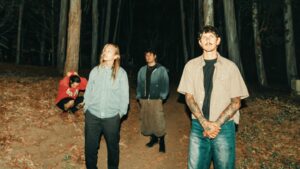
Best friends before they were bandmates, Riff Wood’s Carson Groves, Hyrum Russon and Shredder were just 11 years old when they decided to make music together.

Discovering rock music for the first time as kids, none of them even knew how to play an instrument, but together they figured it out side-by-side. Since then, they’ve been learning the ropes in a huge way, going from school talent shows and backyard parties to releasing their 2025 debut album ‘Tough Luck’ and touring their songs all around the world.
Now, things have levelled up in another mighty way. Working alongside the producer responsible for some of their favourite records, the trio’s second album ‘Butterfly In Black And White’ was recorded with the legendary Rob Cavallo. Retaining all of Riff Wood’s youthful, instinctive rawness while finding the trio increasingly confident in their own identity, it’s a collection of songs that pull from decades of guitar music, wrestling with anxiety, insecurity and growing up, always searching for the brighter side hidden within life’s difficult moments.
Still driven first and foremost by friendship and the simple thrill of making music together, Rock Sound caught up with Riff Wood to talk about finding their sound, the literal spilt milk that inspired the title of ‘Butterfly In Black And White’, and why connecting with people will always matter more to them than chasing success.
ROCK SOUND: Let’s go right back to the beginning, because the way Riff Wood started feels important to everything you do now. It really was as simple as three friends thinking being in a band looked cool, right?
HYRUM RUSSON: “Yeah. We met in elementary school and all became really good friends. The other two had heard some rock music while growing up, but I had never really listened to it before.”
CARSON GROVES: “I knew about rock, but I was definitely more into pop.”
HYRUM: “I always just listened to the radio, and that’s about as far into music as I got. Then we watched this TV show on Netflix called ‘Julie And The Phantoms’, and there’s a band in that show. We were like, ‘It’d be sick to be in a band.’ Me and Carson called the guitar, so all Shredder had was drums.”
RS: When you started writing your own songs, were you thinking consciously about what Riff Wood should sound like, or were you mainly following whatever felt exciting to you?
CARSON: “A lot of our sound was inspired by great bands like Green Day, Blink-182 and Radiohead. I don’t know if we were very picky on how we wanted things to come about though. We like to sit down and write something, bring it to the rest of the guys, go into the studio and play it a few times, then work things out and try to make the best version of the song.
“I don’t think we were very conscious about what it was ultimately going to turn out like. We were just doing what felt right in the moment, and I think it turned out exactly how we wanted it to, purely because we’re just trying to make the song sound good. We’re not thinking too hard about how everything is going to turn out.”
HYRUM: “Especially with our first record, we were listening to a lot of Green Day and wanted to make songs like Green Day. Then, as we listened to more bands, we wanted to make songs that sounded more like those other bands. All those sounds kind of mixed together, and I think we’re starting to develop our own sound now.”
RS: You can really hear that development on this new album ‘Butterfly In Black And White’. Your debut, ‘Tough Luck’, captured you figuring things out, whereas these songs feel much more distinctly like Riff Wood. Was that growth largely natural too?
CARSON: “As we expanded what we were listening to, we started expanding what we were writing. It’s always a very natural thing for us. We try not to be very pushy because I think if you become too strict and push things too hard, the authenticity of it goes out the window.
“As long as we’re listening to new things, trying new things and making it interesting for us while staying true to our sound, I think we’re always going to be writing things we’re proud of. That’s ultimately our goal. You can detect when a band isn’t feeling it, because the fans feel it too, and it all kind of goes downhill from there. It’s about keeping the authenticity there and making sure that you’re loving what you’re doing.
“If that means a slight pivot to a different style of music, then that’s where you should go. Or if that means revisiting an old style of music that you were writing before, then so be it. As long as you are loving it, the fans will likely love it as well. There are always going to be things people don’t like, but I don’t think anyone’s really going to like it if you don’t like it.”
RS: We have to talk about Rob Cavallo. Given his history working on records with the likes of Green Day, My Chemical Romance and Paramore, what was it actually like walking into a studio with someone who has been behind so much iconic music?
HYRUM: “He’s the coolest dude you’ll ever meet, and he’s so funny.”
SHREDDER: “He’s a legend. I was a little scared going down there originally. I was super excited, but a little bit scared. I was like, ‘How strict will he be? He’s had all these hits, so he’s probably going to ground us a little bit.’ But he didn’t really. He just brought out more of what we are and kept it raw when we were recording.”
RS: That must have taught you a lot about the value of an outside perspective too. Is the ideal collaborator someone who can push you without ever trying to fundamentally change what the three of you are?
CARSON: “I think that’s important because what is ultimately most important to us is that the three of us are enjoying what we’re writing, we’re proud of it and we’re progressing. But I think it’s very important to have someone that’s very close to you, but also on the outside of the inner circle. They have a better view of what it looks like from the outside while we’re in the direct middle of it. They can recognise certain things that could be better or something that should be toned down.”
SHREDDER: “Rob is perfect for that. He has the perfect chemistry for what we want this band to sound like.”
RS: There’s been a hell of a lot of lyrical growth coming into this album too. So much of this record is about acknowledging difficult moments without allowing them to completely overwhelm the good. Why do you think you naturally found yourselves writing about that balance?
HYRUM: “Me and Carson like to say that when we’re writing lyrics, some have to do with personal experiences and some are just observing what’s around us. When we’re writing, we always want our fans to connect with it. We realised pretty early on that everyone goes through tough stuff, but we want to have hope in all of it.
“‘Manufactured Tragedy’ and ‘Butterfly In Black And White’ are the main songs that encapsulate that. ‘Butterfly In Black And White’ is about how you can go through good things and bad things, and you can look at them whichever way while still having hope through it. Then ‘Manufactured Tragedy’ is about looking at the positives when you’re in a negative situation.
“We liked that idea of positive and negative, and how it relates to the black and white. Some of the other songs encapsulate that message as well. I don’t know if there’s a specific reason we wanted to go towards that, but again, it happened so naturally.”
RS: Of course, that idea of contrast brings us perfectly to the album title. Where did ‘Butterfly In Black And White’ actually come from?
HYRUM: “The entire album literally came from me pouring a glass of milk and spilling it. Carson was like, ‘Wait, don’t clean it up. It looks like a butterfly.’”
CARSON: “I took a picture on my phone and put it through a thousand different filters on my camera editing app. We were like, ‘Wait, this looks like a butterfly in black and white.’ We did a quick Google search of what it means to spot a butterfly in black and white, and some cultures believe it represents positive change, while other cultures believe it’s death and misfortune. That was what really sparked the idea of the yin and yang thing, the good and bad of life and the duality of things. It all just came from a milk spill.”
HYRUM: “What’s interesting is that we actually had the idea before our first record. We hadn’t even come up with the album name for ‘Tough Luck’, but we knew we wanted our second album to be called ‘Butterfly In Black And White’.”
CARSON: “For some weird reason, we were like, ‘This is for the next thing. This isn’t our debut, this is the next album cover.’”
SHREDDER: “We actually used that picture of the spilled milk on a bunch of different band invitations back when we were in seventh grade. We’d just throw that thing on there and be like, ‘Come see the show!’”
RS: As people who have found so much meaning in your favourite bands’ songs, are you conscious of giving listeners enough space to find their own stories within what you write?
CARSON: “100 per cent. There are even times where I’ll be writing a song and I’ll think to myself, ‘How are we going to perform this live? What can I add that’ll make this better?’
“We have a song called ‘PUNK’, for example, and there’s this part where I was like, ‘I need something hooky that the crowd can sing.’ When we play it live, I want to encourage everyone to sing that ‘woah’ part because there aren’t even any lyrics. Anyone can sing that.
“It’s the same for the messages of our songs, too. We write about some personal things to us, but then we also write about universal feelings that everyone has felt. ‘Manufactured Tragedy’ is a good example. Everyone has struggled with finding the positives in the midst of all the negatives. I knew everyone could relate to that, but I wanted to figure out how I could word things to get that message across. The feedback from that song has been really inspiring because a lot of people have reached out saying, ‘This really helped me,’ or, ‘I really connect with this.’ That’s so great to see because that’s what it’s all about.”
HYRUM: “You can even be connected to your own song for different situations. Sometimes I’ll write a song in one place and I’m feeling a certain way, then I come back to it a year later when I’m going through something else, and those lyrics mean something different to me again.”
CARSON: “The songs are always adapting and changing as you change.”
RS: Let’s talk about another track on the album, ‘Shy Guy’. That one taps into the feeling of being overwhelmed or not quite fitting in without ever becoming this huge, forced anthem about outsiders. Where did that one come from?
SHREDDER: “I think we had something good going when we originally wrote it, and we just didn’t know it because it was one of the first four or five songs we’d ever written. It was going to go on the first album, but the version we had of it then was just terrible. Two years later, when we were working on this second record, we revisited the chorus in the studio and were like, ‘Actually, that’s kind of good.’ We mixed two songs, and I think it came out really cool.”
HYRUM: “That’s one where we all worked on the lyrics together. Usually it’s just me and Carson, but we had Shredder help us because me and Carson couldn’t think of anything. The reason it doesn’t come off as forced, in my opinion, is because it really isn’t. It’s not about a super shy person, it’s just about when you need some alone time. When you’re in a crowded room, your social energy is just gone, and you want to go chill and watch a movie. We’re not shy people, but everyone needs to be alone sometimes.”
CARSON: “That ultimately comes back to the universal thing, because everyone at some time feels that. We’re not shy people, it’s just about feeling overwhelmed and trying to get out of it for a minute. It could be about anyone.”
RS: Something that seems even more important than the music itself is the friendship between the three of you. You were friends first, then essentially learned how to become musicians together. How fundamental is that bond to what Riff Wood is?
HYRUM: “The fact that none of us knew how to play instruments when we decided to become a band, and then we all learned them together and built up the band at the same time… We were all on the same road. I think that really helped with the friendship.
“The reasons behind why you’re doing it are important. None of us are doing this to be famous or to get money. It’s really because we all love music and we love making it together. Most of all, we want to change the world with our music, connect with people and be a positive force. We want to help people escape from whatever problems they’re going through.”
RS: You made your debut without really knowing what was possible for this band. Now you’ve travelled, seen people connect with the songs and had rooms singing them back to you. Has that made you start dreaming a little bigger about where Riff Wood could eventually go?
CARSON: “We definitely have dreams. We’d love to fill an arena with fans, and not just to say that we filled out an arena. It’s about the feeling that we get when we perform our songs and people sing them back to us… it’s one of the greatest feelings in the world.
“Getting more people in those rooms makes that feeling even better. Not only do you feel it onstage, but the people in the crowd feel it too. They’re singing along with thousands of people who all have different reasons for being there. Of those people, there are also going to be people going through the same things.
“That’s such a beautiful thing, so we definitely have big dreams in that sense. We really want to share our music with the world, get as many people to listen to it and connect to it, and hopefully help them feel better in whatever way they need to. At the same time though, we’re just taking it day by day. You can’t get to the big thing without the little steps, so we think about the day-to-day with big things in mind.”
‘Butterfly In Black And White’ is out now via Giant Music.
Riff Wood will return to the UK for a series of intimate in-store shows later this month.
Catch them at the dates below.
SEPTEMBER
29: NOTTINGHAM Rough Trade
30: LONDON Rough Trade Denmark Street
OCTOBER
1: BRISTOL Rough Trade